
What Military Branch Should I Join
Choosing which military branch to join is one of the biggest decisions you’ll ever make. Each branch offers different missions, cultures, career paths, and lifestyles. Get it right, and you’ll thrive. Get it wrong, and you’ll spend years in the wrong environment. Here’s how to find your best fit.
🎯 Understanding the Five Military Branches
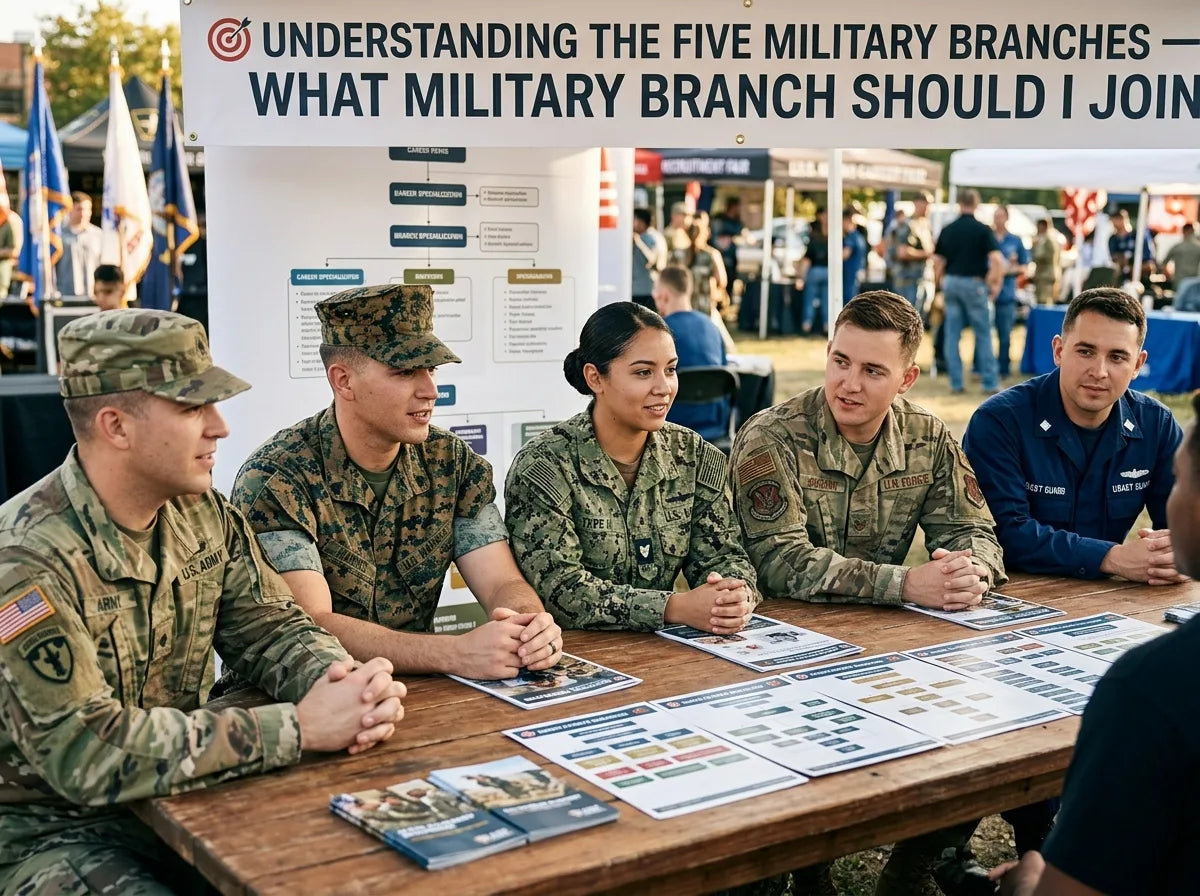
The United States military is made up of five active branches, each with a distinct mission and identity. Before comparing them, you need to understand what each one actually does day-to-day, not just the recruitment poster version. Your daily life, deployment frequency, and career options depend heavily on which branch you choose.
Army
The U.S. Army is the largest branch, with the broadest range of jobs (called MOSs – Military Occupational Specialties). It focuses on land-based operations and offers hundreds of career paths from infantry to intelligence, engineering, and healthcare. If you want variety and the largest support network, the Army delivers that. Expect frequent deployments and a wide range of duty station options worldwide.
Navy
The U.S. Navy operates at sea, in the air, and increasingly in cyberspace. Sailors spend significant time aboard ships, which means long deployments away from home, sometimes six to nine months at a stretch. The Navy is ideal if you’re drawn to maritime environments, aviation, or elite programs like the Navy SEALs. It also offers strong technical and engineering career tracks.
Marine Corps
The U.S. Marine Corps operates under the Department of the Navy but maintains its own fierce identity. Marines are known for the most demanding basic training and a warrior culture that emphasizes discipline and combat readiness. The branch is smaller, which means tighter-knit units but fewer job specialties. If you want the toughest challenge and a brotherhood-driven culture, this is it.
Air Force
The U.S. Air Force focuses on air and space superiority. It’s widely considered to offer the best quality of life among the branches, with better base facilities, housing, and work-life balance. If you’re interested in aviation, cybersecurity, space operations, or technical careers, the Air Force is a strong option. Competition for top jobs is high, and ASVAB scores matter significantly here.
Coast Guard
The smallest branch, the U.S. Coast Guard, handles maritime law enforcement, search and rescue, and port security. It operates under the Department of Homeland Security during peacetime. The Coast Guard is harder to join due to stricter entry standards, but it offers a unique mission focused on domestic protection rather than overseas combat deployments.
📊 Military Branch Comparison at a Glance
| Branch | Focus | Best For | Quality of Life | Enlistment Difficulty |
|---|---|---|---|---|
| Army | Land operations | Job variety seekers | ⭐⭐⭐ | Moderate |
| Navy | Sea, air, cyber | Travel, tech careers | ⭐⭐⭐ | Moderate |
| Marine Corps | Expeditionary combat | Discipline, challenge | ⭐⭐ | Hard |
| Air Force | Air and space | Tech, aviation, comfort | ⭐⭐⭐⭐⭐ | Competitive |
| Coast Guard | Maritime security | Domestic mission focus | ⭐⭐⭐⭐ | Very Hard |
✅ Key Factors to Consider Before Choosing a Branch

There’s no universally “best” branch. The right answer depends on your personal priorities, physical fitness, career goals, and tolerance for certain living conditions. Most people make the mistake of choosing based on image alone. Instead, evaluate these core factors honestly before signing anything.
Your Career Goals
Every branch offers different job opportunities. If you want to work in aviation or cybersecurity, the Air Force and Navy have deep programs in those areas. If you want healthcare or medical training, the Army has the widest selection of medical MOSs. Research specific jobs within each branch before assuming one branch is better overall.
Physical Fitness Standards
Each branch has different physical fitness tests and standards. The Marine Corps sets the highest bar, followed by the Army and Navy. The Air Force and Coast Guard have rigorous standards too, but the culture around physical training differs. Be honest about your current fitness level and how much you’re willing to push yourself in training environments.
Deployment and Lifestyle Preferences
If being away from home frequently is a dealbreaker, the Navy’s long sea deployments may not suit you. The Air Force generally offers more predictable schedules and better base amenities. The Army deploys heavily depending on your MOS. Understanding deployment tempo before you enlist can prevent serious dissatisfaction down the line.
Education and Advancement Opportunities
All branches offer tuition assistance and access to the GI Bill, but the culture around education varies. The Air Force actively encourages college degrees for career advancement. The Army offers more immediate promotion opportunities for enlisted soldiers who perform well. If long-term education is a priority, factor in each branch’s support structure for that goal.
If you’re considering a specialized medical career path, it’s also worth exploring what military branch is psychiatry aligned with, since mental health roles are distributed differently across branches and can significantly shape your service experience.
⚠️ Common Mistakes When Picking a Military Branch

Many recruits choose a branch for the wrong reasons, and it costs them years of frustration. Awareness of these common errors can save you from a mismatched enlistment.
- Choosing based on movies or pop culture – Real military life rarely resembles Hollywood portrayals
- Ignoring your ASVAB scores – Low scores limit your job options significantly in every branch
- Not visiting a recruiter from multiple branches – Talking to only one recruiter gives you a one-sided picture
- Overlooking Reserve and National Guard options – These can offer service without full-time commitment
- Underestimating the culture shock – Each branch has a distinct internal culture that affects daily life
- Focusing only on signing bonuses – Bonuses change frequently and shouldn’t drive your entire decision
🎯 Active Duty vs. Reserve: Another Layer to Consider

Beyond choosing a branch, you also need to decide between active duty and reserve service. Active duty means full-time military service with full pay and benefits. Reserve or National Guard service means part-time commitment, typically one weekend per month and two weeks per year, with the possibility of being activated during national emergencies or conflicts.
Reserve service lets you maintain a civilian career while gaining military training, education benefits, and some retirement options. Active duty provides more immersive experience, faster career progression, and comprehensive benefits including housing allowance and full healthcare. Neither is superior, it depends entirely on your life situation and long-term goals.
💡 How to Make Your Final Decision

Once you’ve researched each branch, the best approach is to take concrete steps rather than overthink it from a distance. Here’s a practical process to move forward with confidence.
- Take the ASVAB practice test to understand which jobs you’d qualify for across branches
- Visit recruiters from at least two or three different branches and ask hard questions
- Talk to veterans or active-duty members from the branches you’re considering
- Research specific job (MOS/rate/AFSC) availability in your preferred branch
- Consider where you want to be in 10 years and which branch best supports that path
It’s also worth noting that military service has a long history in American leadership. Exploring which presidents served in the military shows how different branches shaped the careers and characters of some of the country’s most influential figures, a reminder that the branch you choose can define far more than just your years of service.
Your ASVAB score is one of the most important numbers in this process. A higher score opens more doors in every branch. Don’t rush enlistment before preparing for that test thoroughly. Many recruiters will push you to sign quickly, but taking a few weeks to study can dramatically expand your options.
Conclusion

There’s no single answer to which military branch you should join. The Army offers the most jobs, the Marines the toughest culture, the Navy the most travel, the Air Force the best quality of life, and the Coast Guard the most focused domestic mission. Match the branch to your goals, your lifestyle preferences, and your strengths. Do your research, talk to real service members, and choose with your future in mind, not just the present moment.