
Is Employing Military Spouses Special for Private Employers
Hiring military spouses can feel like a straightforward good deed, but there’s more to the picture. Private employers often wonder whether special rules, tax incentives, or legal obligations apply. The answer involves federal programs, real business benefits, and some common misconceptions worth clearing up before you make your next hire.
⚖️ What Does “Special” Actually Mean for Employers?

When employers ask whether hiring military spouses is “special,” they usually mean one of two things: are there legal requirements to prioritize military spouses, or are there financial perks for doing so? The honest answer is that private employers have no federal mandate to hire military spouses, but several meaningful incentives exist that make it a strategically smart decision.
Unlike federal contractors or government agencies, which operate under specific hiring preference rules, private companies operate with full discretion. That said, “discretion” doesn’t mean “no benefit.” The federal government has built a framework of tax credits and workforce programs specifically designed to encourage private sector employers to bring military spouses on board.
The Difference Between Preference and Incentive
Military spouse hiring preference is a formal system that applies to federal government positions and some federal contractor roles. It gives qualifying spouses priority consideration during recruitment. Private employers are entirely outside this system.
Incentives, on the other hand, are voluntary programs that reward private employers with financial benefits. These are the tools most relevant to businesses asking this question. Understanding the distinction saves time and sets realistic expectations for HR teams and business owners alike.
💰 Tax Credits Available to Private Employers

The most tangible benefit for private employers is the Work Opportunity Tax Credit (WOTC). This federal program allows businesses to claim a tax credit when they hire individuals from specific target groups, and military spouses are among the eligible categories.
Specifically, a military spouse qualifies if they are hired within one year of their active-duty spouse being deployed to a location outside the United States for at least 90 days, or if the active-duty spouse has a service-connected disability. The credit can be substantial, making it a real financial consideration for small and mid-size businesses.
How the WOTC Works for Military Spouse Hires
To claim the credit, employers must complete IRS Form 8850 (Pre-Screening Notice) and submit it to their state workforce agency within 28 days of the new employee’s start date. The process is administrative but manageable, especially for companies already familiar with WOTC for other target groups.
- Credit can reach up to $9,600 per qualified employee depending on hours worked and wages paid
- The employee must work at least 120 hours in the first year to trigger the minimum credit
- Employees working 400+ hours generate the maximum credit percentage
- The credit applies to wages paid during the first year of employment
- Businesses of any size can participate, including nonprofits for certain target groups
It is worth noting that the WOTC is a non-refundable tax credit, meaning it reduces your tax liability but does not result in a refund if the credit exceeds what you owe. Carry-forward provisions apply in most cases.
🎯 The Business Case Beyond Tax Credits

Tax incentives are one piece of the puzzle, but many employers who actively recruit military spouses report operational advantages that go beyond the financial. Military spouses bring a distinctive professional profile shaped by years of adapting to new environments, managing complex logistics, and often working across multiple industries.
Frequent relocations due to Permanent Change of Station (PCS) orders mean military spouses often have experience in multiple industries, regions, and workplace cultures. This adaptability translates well into roles that require flexibility, quick onboarding, and cross-functional communication.
Workforce Qualities Common Among Military Spouses
Research from organizations like the RAND Corporation has documented the employment challenges military spouses face, including gaps caused by relocations and limited local job markets. Despite these barriers, many military spouses develop a resilience and professional versatility that employers find genuinely valuable.
- Strong problem-solving skills developed through managing household operations during deployments
- Experience navigating bureaucratic systems, which translates to administrative roles
- High motivation to maintain career continuity despite structural obstacles
- Community leadership experience through military family support organizations
- Multilingual skills gained from overseas assignments
These are not soft generalizations. They reflect documented patterns across a population that has navigated significant professional disruption while maintaining career ambitions. Employers in sectors like healthcare, technology, logistics, and education have found military spouse hires to be highly engaged and low-turnover employees when given stable, remote-friendly, or flexible roles.
🪪 Legal Protections Employers Should Understand

While private employers are not required to give military spouses preferential treatment in hiring, there are legal protections that apply once a military spouse is employed. The Uniformed Services Employment and Reemployment Rights Act (USERRA) is the most important federal law in this space.
USERRA protects the employment rights of service members, but it also has implications for military families. If an employee is a service member who leaves for active duty, they have reemployment rights upon return. Understanding this law matters for employers who may hire someone with dual military household status, or who may have employees called up to service during their tenure.
Just as understanding identification requirements matters across different contexts, knowing your obligations under military-related employment law is essential. For example, just as people ask whether a military ID is a Real ID for compliance purposes, employers should verify which federal protections apply to their specific workforce situation.
State-Level Considerations
Some states have gone further than federal law by creating their own military spouse employment protections or additional incentives. States like Virginia, Texas, and North Carolina, which host large military installations, have developed programs that include expedited professional license transfers for military spouses who relocate.
For employers, this means that a military spouse who holds a professional license in another state may be able to obtain a valid local license faster than a typical applicant. This reduces onboarding delays in licensed professions like nursing, teaching, real estate, and counseling.
| Factor | Federal Level | State Level |
|---|---|---|
| Hiring Mandate | ❌ None for private employers | ❌ Generally none |
| Tax Incentive | ✅ WOTC credit available | ✅ Varies by state |
| License Portability | ⚠️ Limited federal support | ✅ Many states expedite |
| Employment Protections | ✅ USERRA applies | ✅ Additional state laws |
| Remote Work Programs | ⚠️ No mandate | ✅ Some state programs |
🤝 Programs That Connect Employers With Military Spouses
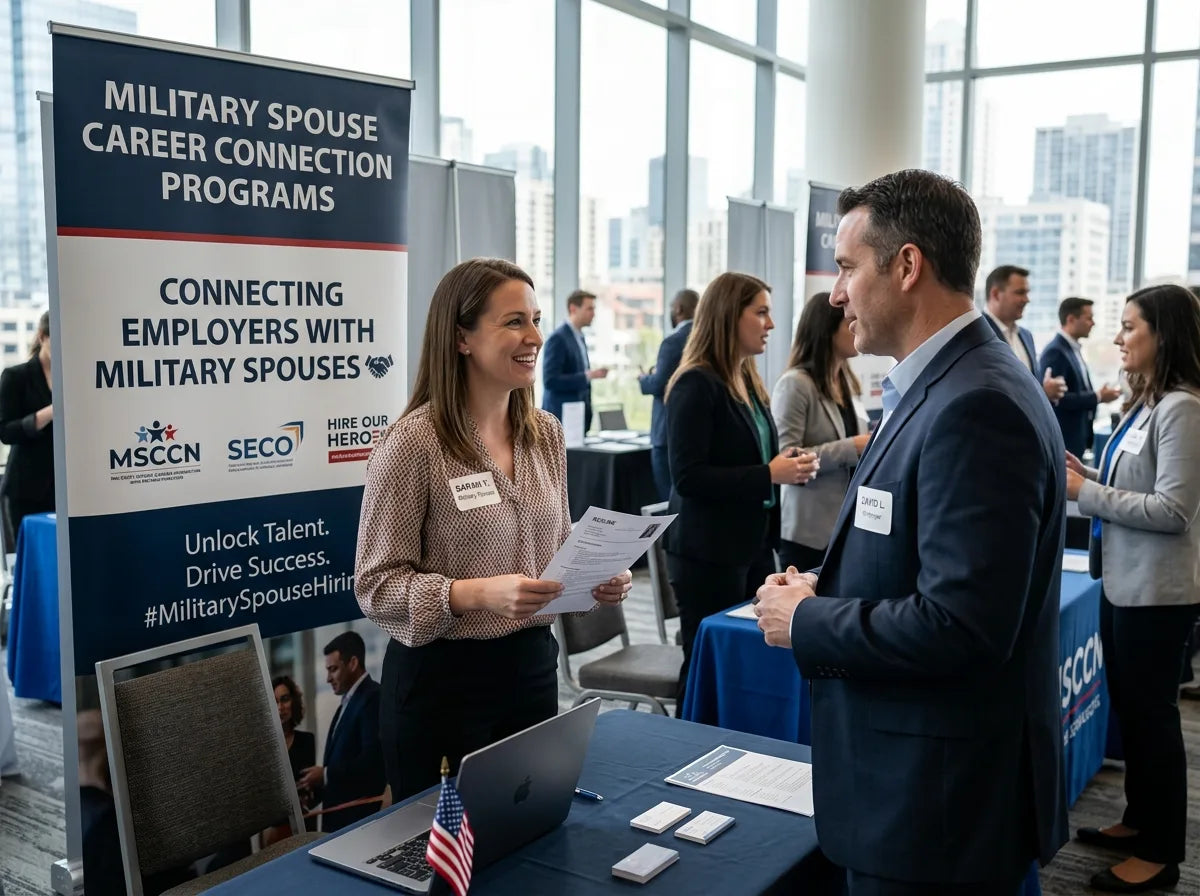
Several established programs exist specifically to bridge the gap between private employers and military spouse job seekers. Participating in these programs is voluntary but signals a genuine commitment to this workforce segment, which can strengthen employer branding among military communities.
The Hiring Our Heroes Military Spouse Program, run by the U.S. Chamber of Commerce Foundation, connects employers with military spouses through fellowships, hiring events, and employer pledges. Companies that participate gain access to a pre-vetted talent pool and visibility among military families who actively share employer reputation information within their networks.
Notable Programs Worth Exploring
- Hiring Our Heroes – Fellowship and direct hire programs through the Chamber of Commerce Foundation
- SECO (Spouse Education and Career Opportunities) – DoD-run program offering career coaching and employer connections
- Blue Star Families – Nonprofit connecting employers with military family talent pipelines
- Military Spouse JD Network – Focused on legal professionals facing bar exam and licensing barriers
- MyCAA Scholarship Program – Funds education for spouses, producing a pipeline of newly credentialed candidates
Employers who register with these programs often report that the quality of candidates is high and the referral network within military communities is strong. A positive reputation as a military-spouse-friendly employer can reduce recruiting costs significantly in regions near military bases.
📋 Practical Steps for Private Employers

If you’re a private employer who wants to take advantage of the available incentives and tap into the military spouse talent pool, the process is more straightforward than it might appear. The key is knowing which steps to take in what order.
Start by registering with your state workforce agency to participate in the WOTC program. Then review your job postings to identify roles that are compatible with the flexible scheduling or remote work arrangements that make positions accessible to military spouses who may face geographic or logistical constraints.
Financial planning also plays a role in attracting and retaining this workforce segment. Military families often deal with complex tax situations related to service pay, allowances, and multi-state filing. If your company offers financial wellness resources or employee assistance programs, highlighting access to tools like learning whether TurboTax is free for military members and their families can be a meaningful perk that resonates with this community.
Quick Employer Checklist
- Register with your state workforce agency for WOTC eligibility
- Complete IRS Form 8850 within 28 days of qualifying hires
- Review job postings for remote or flexible work compatibility
- Partner with at least one military spouse employment program
- Train HR staff on USERRA obligations and military family considerations
- Highlight military-friendly policies in job listings and employer branding materials
None of these steps require significant investment. Most are administrative adjustments that position your company to access a motivated, skilled, and underutilized talent pool while capturing available tax benefits.
✅ Final Thoughts

Hiring military spouses is not legally required for private employers, but it is financially incentivized and professionally rewarding. The WOTC credit alone can offset significant hiring costs, while the workforce qualities military spouses bring add long-term value. Programs like Hiring Our Heroes make the connection easy. For employers willing to offer flexibility and recognize non-linear career paths, military spouses represent one of the most overlooked and capable talent pools available. The business case is clear, and the programs to support it are already in place.